
Tagaloa Tiles
A castaway, a chain of talking island guardians, and a stone path whose next tile might be safe. Here is how the game works today, and how the older island design became the current mobile test.
For adults 18+. All stakes and rewards are fictional in-game items with no cash value or real-world prizes. Tagaloa Tiles is in internal testing; the material below describes the current test and clearly labels earlier concepts.
Choose a stone. Decide when to stop.
At a Mines table, each step presents a row of stone tiles. On an ordinary round, one tile in the row hides a mine. Choose a safe tile to advance and increase the potential Coin return. After a safe step, you can take the current return or risk another row. A mine ends the round, subject to any insurance selected before it began.
Tables vary in width and length: the starting 3×6 board has three choices at each of six steps. Other boards range from 2×3 to 6×15 and become available through progression. A Key starts a round, while Coins are the fictional stake and reward.
A 3×6 example
With three tiles and one mine per row, an ordinary round has two safe choices out of three at each step. The first safe step uses a gross return coefficient of 1.44 times the Coin stake. For a 100-Coin stake, that is 144 Coins returned in total if you stop there. Reaching the sixth row is less likely but offers a larger return. Whole-Coin rounding can affect small stakes.
The current internal test also includes an introductory guaranteed-safe round and periodic safe rounds. Those change the overall results, so the ordinary-round example is not a promise of what a session will return. No real money can be won.
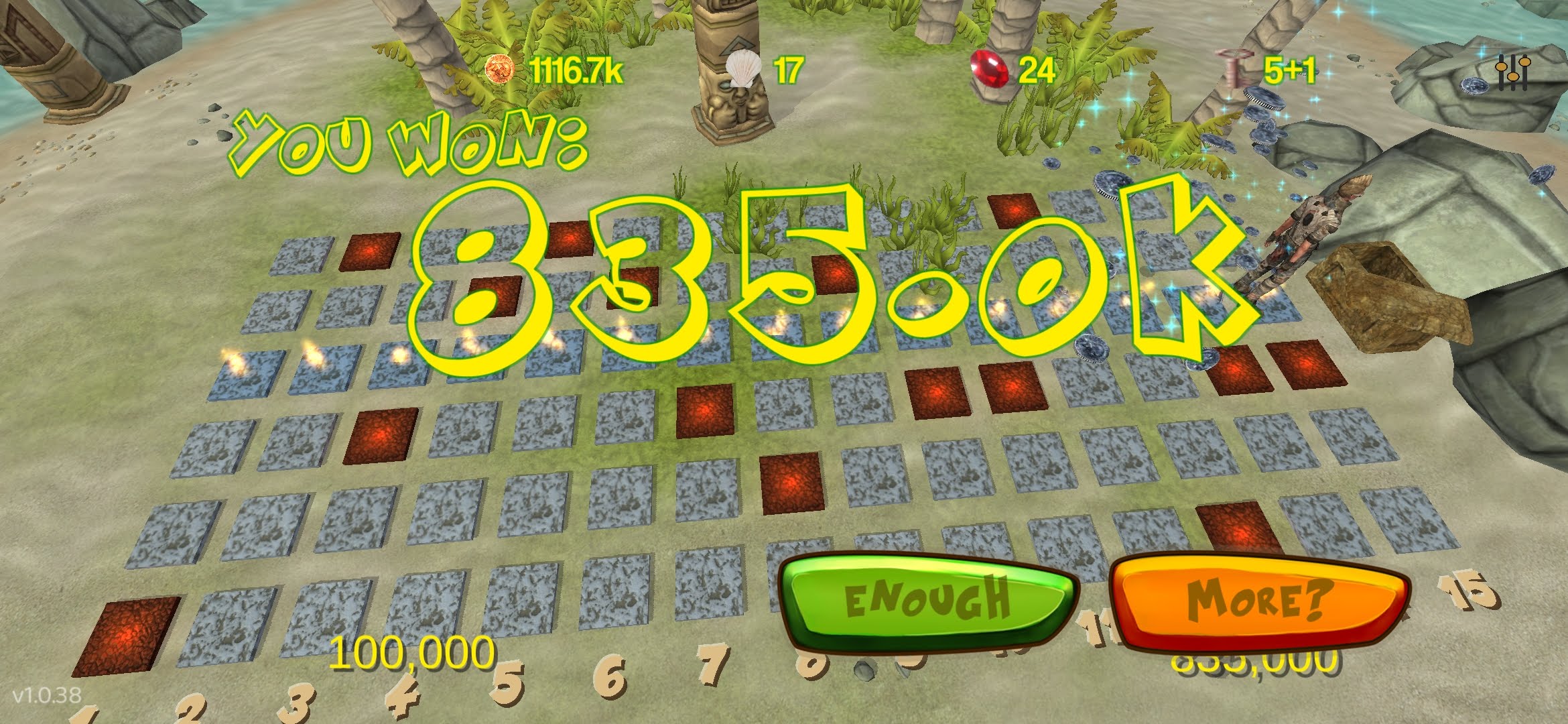
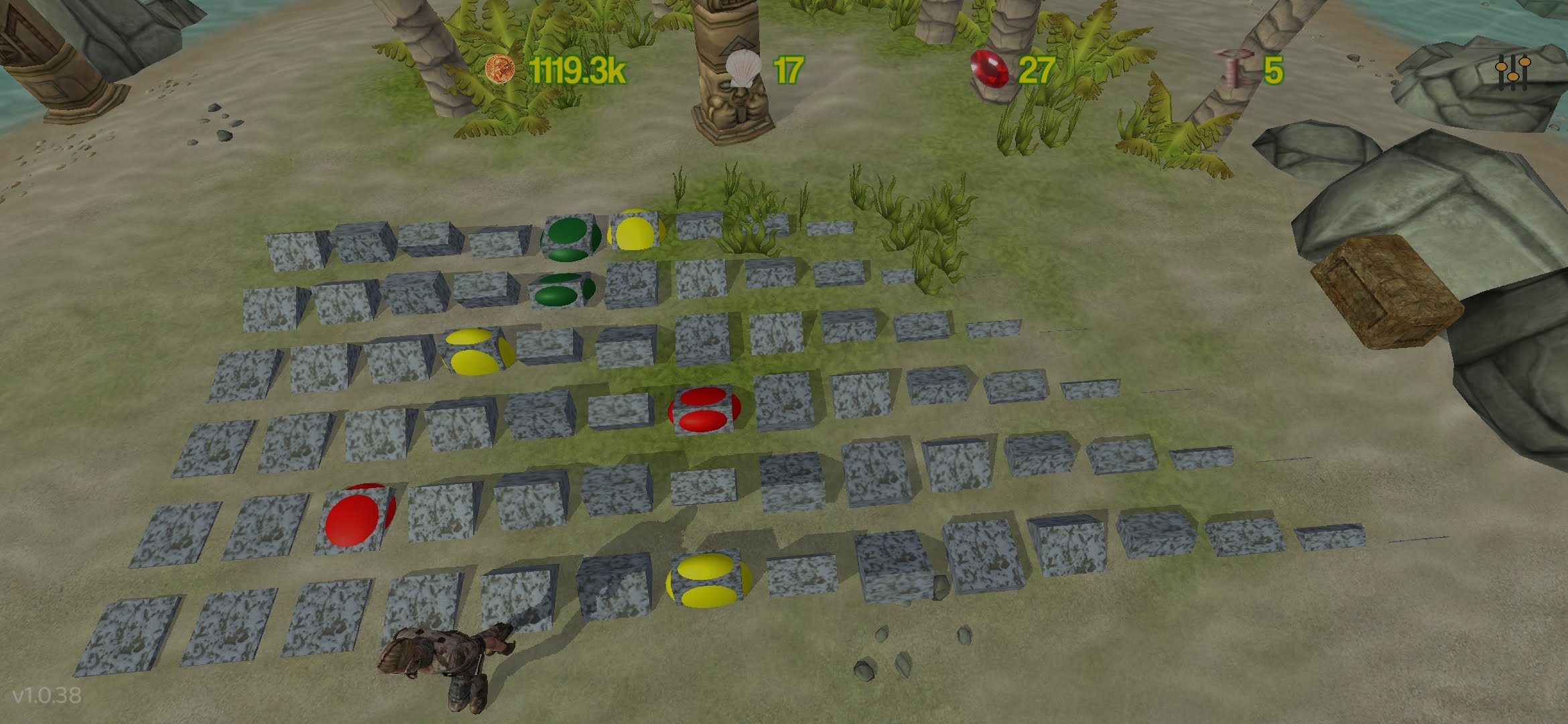
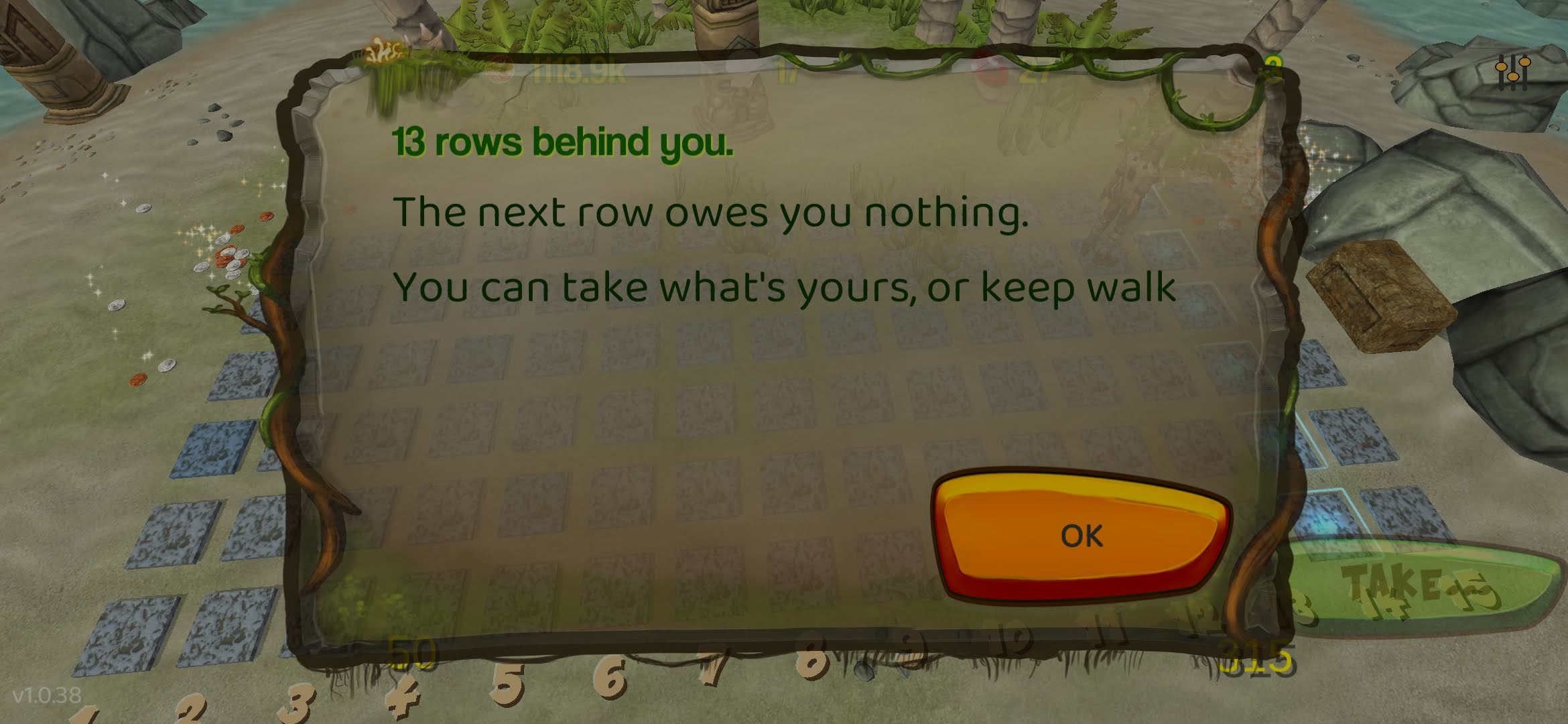
Screenshots captured from the Android internal test, version 1.0.38. Select an image to view it full size.
Another playable encounter is the Boatman's Shell Game: pick one of three shells for a chance at a fictional Coin return. The Boatman also connects parts of the island that have been unlocked. The current test includes island exploration, conversations, Mines, and the Shell Game; Marble Race, live multiplayer, and personally owned islands are still design ideas or prototypes, not playable release features.
Stone-path return coefficients
These are the five Mines tables in the current Unity test scene. Each column names a board: the first number is the number of tiles to choose from at each step, and the second is the number of steps. A cell gives the gross Coin return multiplier after safely completing that step and choosing to stop. For example, at step 2 of a 3×6 table, ×2.07 means a 100-Coin stake returns 207 Coins in total, including the original stake.
| Safe steps | 2×3 | 3×6 | 4×9 | 5×12 | 6×15 |
|---|---|---|---|---|---|
| 1 | ×1.92 | ×1.44 | ×1.28 | ×1.20 | ×1.15 |
| 2 | ×3.69 | ×2.07 | ×1.64 | ×1.44 | ×1.33 |
| 3 | ×7.08 | ×2.99 | ×2.10 | ×1.73 | ×1.53 |
| 4 | — | ×4.30 | ×2.68 | ×2.07 | ×1.76 |
| 5 | — | ×6.19 | ×3.44 | ×2.49 | ×2.03 |
| 6 | — | ×8.92 | ×4.40 | ×2.99 | ×2.34 |
| 7 | — | — | ×5.63 | ×3.58 | ×2.69 |
| 8 | — | — | ×7.21 | ×4.30 | ×3.10 |
| 9 | — | — | ×9.22 | ×5.16 | ×3.57 |
| 10 | — | — | — | ×6.19 | ×4.12 |
| 11 | — | — | — | ×7.43 | ×4.74 |
| 12 | — | — | — | ×8.92 | ×5.46 |
| 13 | — | — | — | — | ×6.29 |
| 14 | — | — | — | — | ×7.25 |
| 15 | — | — | — | — | ×8.35 |
On an ordinary round, one tile per row hides a mine. If a board offers n tiles per row, the chance of safely finishing k rows by choosing without inside knowledge is ((n − 1) / n)k. On the 3×6 board, that makes the ordinary chance of reaching the last row about 8.8%; its full-route multiplier is ×8.92. This calculation describes ordinary rounds only. The introductory and periodic guaranteed-safe rounds have different outcomes, and insurance, rewards, and whole-Coin rounding also affect a session. These numbers are game-design information, not real-money odds or a promise of earnings.
Why the island has guardians
The player wakes on a shore after a shipwreck. The Watcher is the first guardian encountered. He leads the player toward the Keeper, who explains the island's story; the Broker provides a starting Coin and opens a path to more tables; the Dealer teaches the stone-path game. Other guardians provide travel and optional encounters. The sequence makes the mechanics part of an island story rather than a disconnected menu of games.
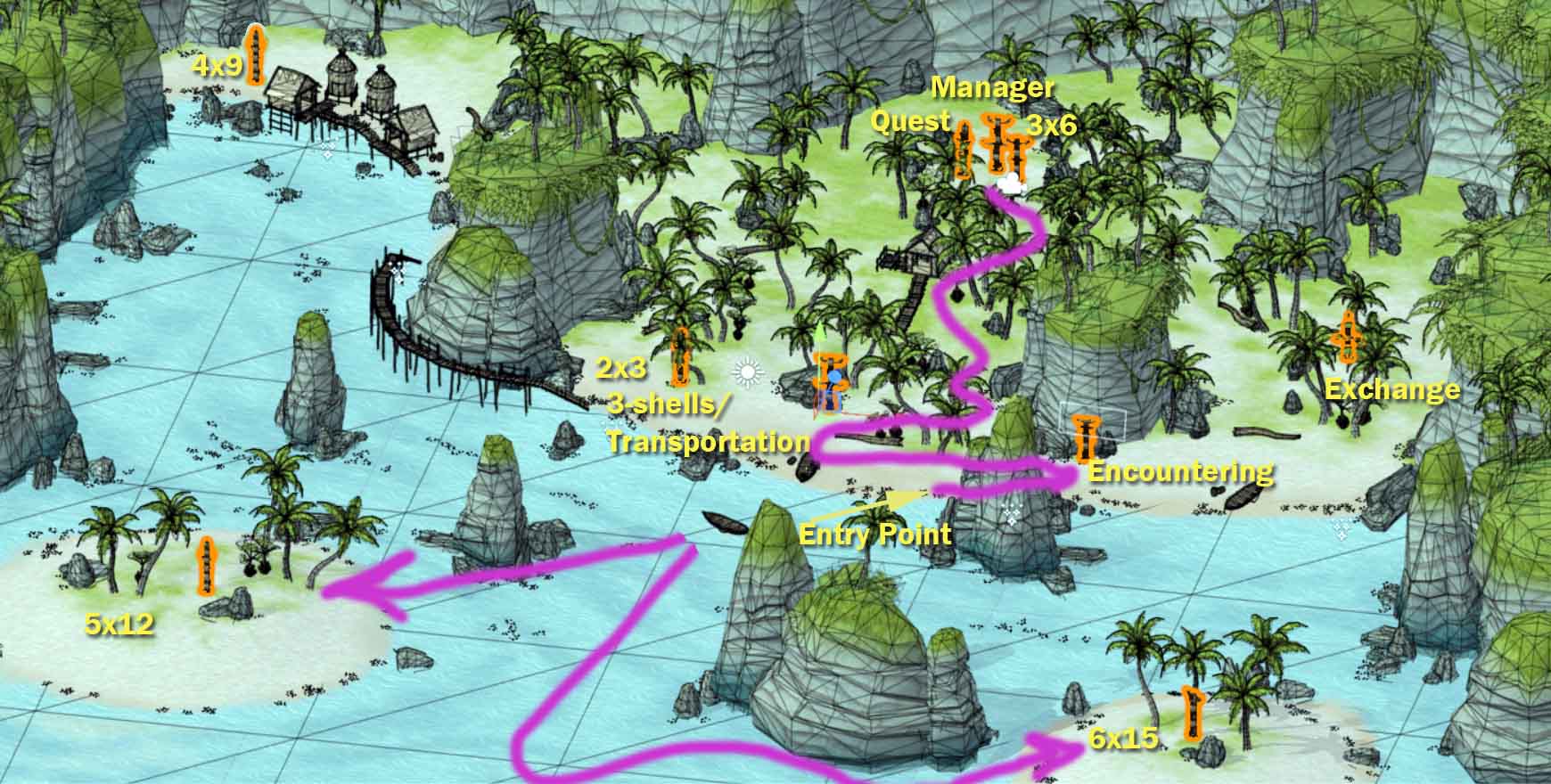
The early plan linked an entry point to an encounter guardian, a glade of three central guardians, and several differently sized stone paths. In the current test, we have kept the useful idea of meeting characters before unlocking activities, while simplifying the first release to features that can be played and tested now.
From prototype diagram to playable dialogue
The island project began as a 2016 concept and remained unfinished for years. Its design document contains board sizes, reward tables, travel ideas, quests, and conversations. In the 2026 Unity rebuild, the team narrowed the first release to a coherent route through the island and its playable games.
Dialogue was a particular design problem: a guardian needs to introduce itself, tell the player what to do next, and respond sensibly when visited again. The current first-session path follows the Watcher, Keeper, Broker, and Dealer. Development work has included short, character-specific dialogue, a visible objective during onboarding, saved conversation progress, and recovery after an interrupted round. The richer branching conversations from the old diagrams remain a design direction.
We also revisited the game economy. The original table coefficients are gross returns: the stake is deducted when a round starts, and a successful cash-out credits the displayed return once. That distinction mattered during testing because an earlier implementation accidentally credited the stake twice. The current test uses the corrected settlement, with continuing work on balance and device testing before public release.
For a look at Arvare's earlier augmented-reality work, see our AR video archive on YouTube. We plan to add a recorded Tagaloa Tiles playthrough after it is captured and checked against the current build.
Roman's game: Spelltroum
Spelltroum is a published mobile PvP game that Roman Samchuk developed independently. Roman worked with us at an earlier private company and is now preparing an iOS version of Tagaloa Tiles. Spelltroum's arena battles, heroes, and items are separate from Tagaloa Tiles. Explore the Spelltroum website or see its Google Play listing.
Interested in testing Tagaloa Tiles? Join the tester group, then use the Play testing invite with the same Google account. For questions, write to hello@arvare.com.